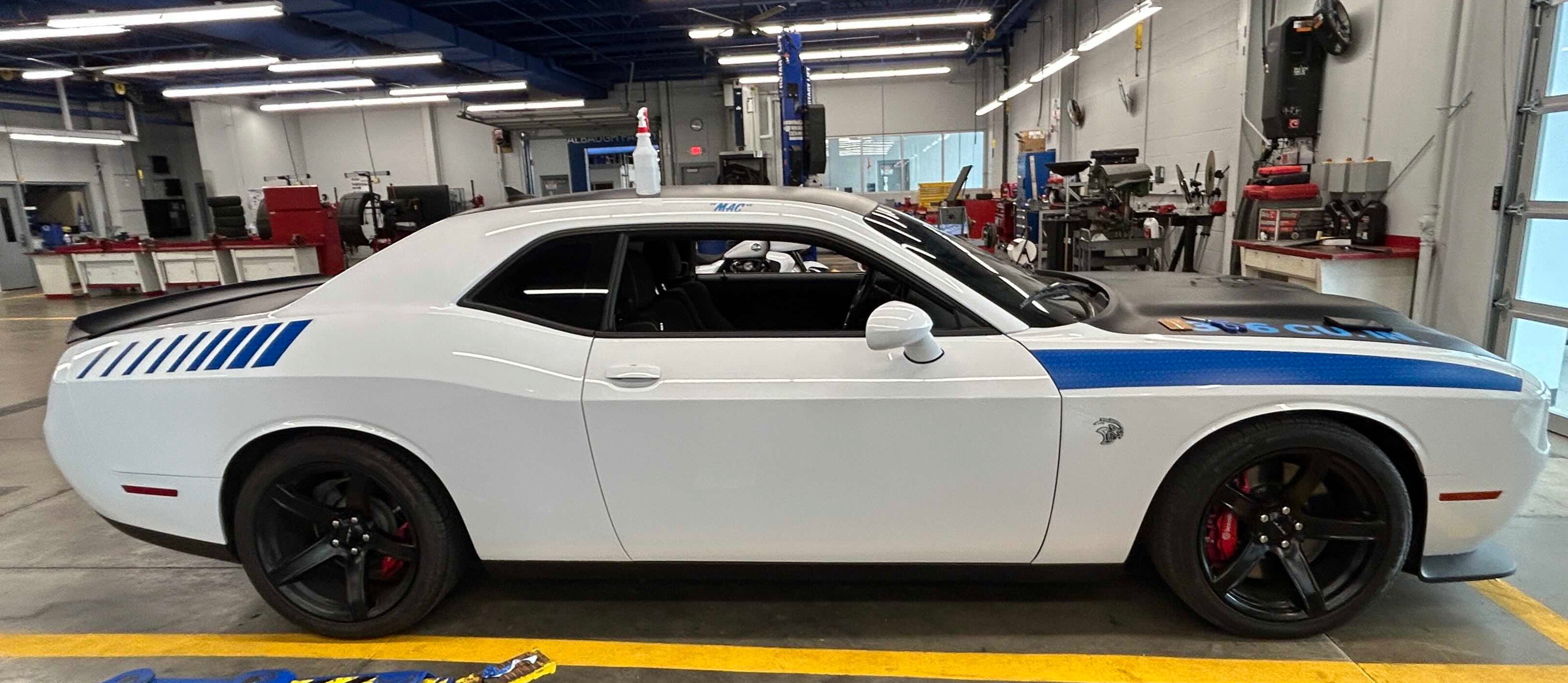
DMACC's Hellcat wrap project started with a simple idea: give students an opportunity to apply what they're learning in a real-world setting.
Building on a longstanding partnership between the college's Design, Media, and the Arts and Building Trades and Transportation Pathways — in which Photography students for years have gained hands-on experience by capturing high-quality images of vehicles in the Automotive program's showroom — faculty saw a new opportunity this year when Graphic Design began incorporating vehicle wrapping into its curriculum.
The result was a collaboration that allowed Graphic Design students to design, print and install graphics on a vehicle used by Automotive students for instruction and recruiting events. As Automotive Program Chair Jerry Burns puts it, projects like this are "DMACC programs working together to support students," while also creating learning experiences that would be difficult for either program to offer on its own.
At the center of the project was Jaysee Ameigh, a Graphic Design student from Saint Charles, Iowa. Ameigh began attending DMACC part-time in summer 2024 and is now wrapping up her degree. A lifelong motorsports enthusiast who grew up in a racing family, she jumped at the chance to combine two of her passions: art and cars.
We asked Ameigh about her experience designing the Hellcat wrap, collaborating with the Automotive program and seeing her work come to life on a real vehicle.
How did you get involved in this design project?
Every time that we were given a little free reign on a project in class, I usually ended up tying it back to motorsports in some way. Heather Purdy, my professor, knew what my passions were, and the opportunity to collaborate with the Automotive program came up. When I heard about the Hellcat project, I thought it would be a really cool opportunity because it combined two thing I'm passionate about: art and cars.
It was also different from a lot of the projects I had worked on in class. Instead of designing something that would just live on the computer or printed on a smaller scale, I got to design something that would eventually be put on an actual vehicle and seen around Iowa.
What inspired your design concepts for the Hellcat wrap project?
When I first got to meet one-on-one with the Automotive program's professors, they gave me a tour of Building 13. Along the walls are these blueprint-type graphics of engines, parts, gears, and other care related items. So, we took inspiration from that. In the front of the building it looks like your typical car dealership showroom. But, when you walk to the back and look a little closer, you get to see what really happens. That's what I also tried to convey in our design. When you look at the car from far away, it looks like your usual vinyl decal, but as you get closer, you can see that car part illustrations make up the entire shape!
What was it like collaborating with DMACC Automotive to bring your designs to life? Did this project give you a chance to do something you otherwise wouldn't have — like using the big printer?
It was really interesting because I got to see how different programs at DMACC can work together to create something that neither program would necessarily do on its own.
From the design side, I was focused on creating the artwork and figuring out how the graphics would communicate with the body lines of the car.
I also got to learn more about the production process, including working with the vinyl printer. That was something I probably wouldn't have had the opportunity to experience in the same way without this project. It was interesting to see the entire process from start to finish.
Did you grow up around racing? Is it true your sister is named "Daytona"?
One-hundred percent. Racing has always been a huge part of my family. And yes, my sister's real name is Daytona!
I grew up around dirt track racing, so cars have always been something I've been naturally interested in. My grandpa, Jack Gyles, was a race car driver and building starting in the late 70s. He was actually inducted into Stuart Speedway's Hall of Fame in 2023. Practically everyone in my extended family races. Because of that, getting to combine graphic design with something automotive-related felt like a perfect fit for me.
Racing and NASCAR is also an industry where graphic design is everywhere. From car wraps to merchandise, and even social media, team branding, and sponsorships, there are so many opportunities for a graphic designer in that world. I think growing up around racing made me notice and appreciate that side of the sport a lot more.
What does it mean to you to see your work showcased on a DMACC vehicle on campus?
It's honestly really crazy (in a good way!)
In high school, I didn't have [access to] the graphic design programs that my fellow [DMACC] classmates did and I felt a little behind. So, getting chosen to do something like this really made the work feel worth it and that my art was worth sharing.
As a student, you're always making things for assignments, and most of the time they exist as a file on your computer or something you turn in and move on from. This project was different because I got to see something I designed become a physical thing that people will see in the world.
What are your post-grad plans? Did this project influence your curiosity about different career paths within the graphic design world?
My goal after graduation is to continue working as a graphic designer and illustrator and to build my portfolio where I can combine my creativity with something I am passionate about.
This project definitely made me more curious about the different directions graphic design can take. Before this, I probably thought more about graphic design in terms of creating thing digitally. Getting to work on a vehicle wrap showed me how much more there is to the process, like large format printing, production, installation, and collaborating with people in completely different realms.
It made me realize that I don't necessarily have to limit myself to only specific type of graphic design. There are so many different paths I could explore, and I think that's one of the biggest things I took away from this experience.